

The profound “that’s OK”
A lesson of non-attachment to validation & a real-life example of how tarot actually works

“Just trust me, you’ll be fine” — haven’t heard that in a while! — I thought to myself, as the line from the song I was dedicating the whole blog post to came up (seemingly) randomly again this morning.
Authenticity and integrity have become the predominant values for me lately, and I’ve been contemplating how to navigate a change that has long been due in my internal world — externally. For a long time, I’ve wanted to focus my attention on working with tarot deeply and solely, but I also write a meditation blog that now and then brings a genuinely warm response from a few people. The single, all-encompassing narrative that exists within me (one where everything fits perfectly together without any conflict) hasn’t been easy to put into words or frame under a single theme or content niche. What’s more, I’ve realized I don’t want to fit into “niches” at all. Rather, I want to make space for my lived experience to be the very key that allows me to share it with others later on.
With that said — and circling back to the headline — let me bring this to the real-life tarot application. Before turning to my mantra journal this morning, I inquired for a message that would be both valid for myself and beneficial to the community, and I received the beautiful, community-oriented card of the 3 of Cups.
For any of you at all familiar with tarot, you may immediately think of the message of shared celebration and gladness. Which is true. But here’s the extra edge to it that makes the whole difference and adds immediate depth to the storyline (pun, as always, intended — considering we are discussing the suit of “cups,” which is all about water and our emotions).
The “edge” I’m talking about comes with the particular choice of a tarot deck, which adds an extra layer to the reading. The deck I “randomly” :)) drew a card from today is called the *Siddhartha Tarot*, and the imagery of its particular 3 of Cups differs significantly: it illustrates Prince Siddhartha during his extreme ascetic phase — specifically, the period of severe fasting he undertook in the forest, shortly before abandoning self-mortification. This crucial narrative beat culminates in his realization that extreme self-denial does not lead to enlightenment, prompting him to give up this path, eat a proper meal, and eventually discover the “Middle Way” under the Bodhi tree.
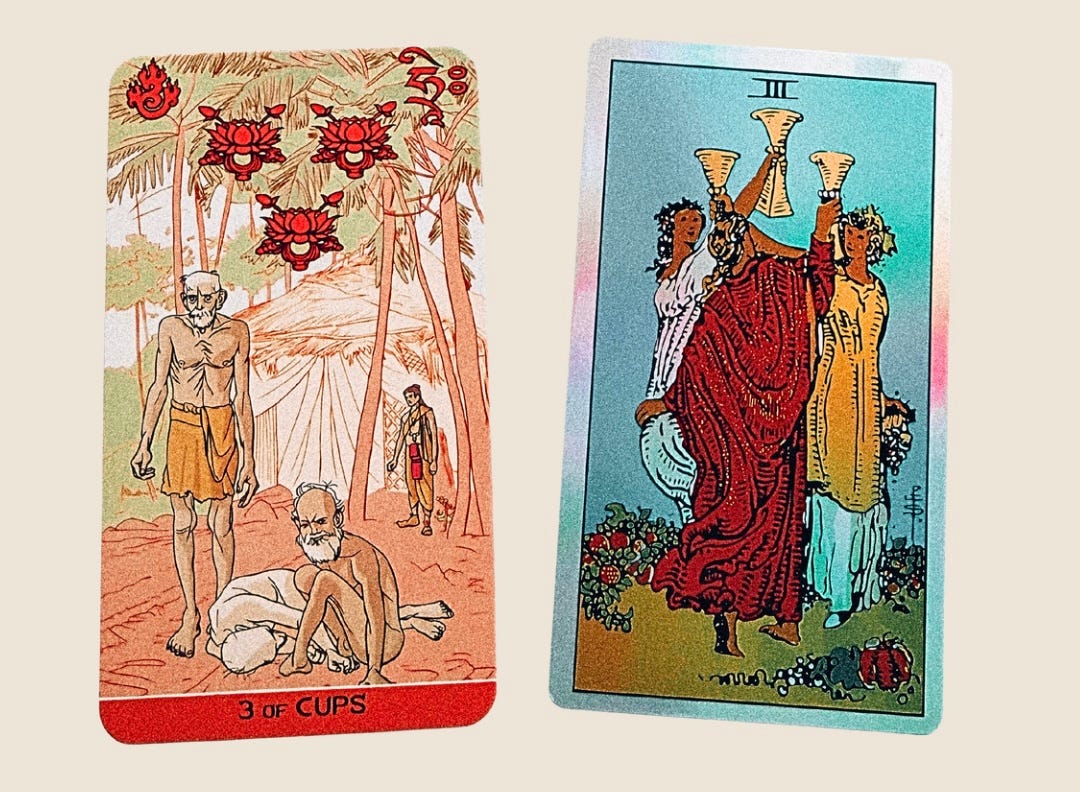
“Middle way” — I thought. Funny. Isn’t that exactly what I was trying to find all along? The middle , inclusive ground for my interests, passions, inclinations — the practice of meditation and the practice of spiritually psychological tarot. So to link the ascetic, somber scene to the traditionally celebratory 3 of Cups, we have to look past the outcome of the card and focus on its core energetic theme: shared emotional experiences. And then apply the Buddhist lesson of non-attachment to validation.
Shared experiences here come in the form of the shared feeling and interest of the small community I’ve managed to build through my posting and writings. In a traditional 3 of Cups, this represents a close-knit group riding the same emotional highs. In the *Siddhartha* deck, the image is about the Buddha-to-be and the ascetics — and how they initially shared the same extreme commitment. I believe people interested in spiritual subjects, and meditation in particular, keep a strong set of beliefs always at play within themselves.
Now, the turning point in the story of the Buddha happens right after this moment. Siddhartha realizes this path of extreme self-mortification is futile and decides to eat. His new invitation — to the “Middle Way” — is his personal leap of faith. My rough intuitive parallel with my own experience here would be the inner calling and need to expand my work beyond the subject of meditation alone, the desire to somehow combine it with the tarot that has served me faithfully through the years — so well that I can’t help but wish to share its benefits with others.
What happens next in the story of Gautama is that when he accepts food from a village girl, his five ascetic companions abandon him immediately. They see his act as a failure, a betrayal of their shared covenant. They do not share his invitation to a new path. They were physically there for the struggle, but emotionally and spiritually they cannot join him. Siddhartha does not run after them, nor does he despair at their rejection. He understands that their perspective is born from their own timeline, and he lets them go in peace. He accepts his solitude and walks to the Bodhi tree. The rest of the story is well-known history.
At no point in this narrative am I trying to compare my humble self to the great Buddha or his unprecedented efforts on the path of enlightenment. I’m simply sharing the storyline that, through the means of tarot, perfectly reflects the events of my current situation (knowing also that in some in|direct way it’s going to aid another person or people — otherwise I wouldn’t even have the fuel of enthusiasm to put this contemplation together).
Now how exactly does it fit the narrative ?
I’ve noticed that every time I’ve shared anything tarot-related with my current meditation community, the feedback has been close to none, which made me realize over and over again that “merging” these two worlds — meditation and tarot — through this current online blog probably won’t really lead me anywhere, and most likely will make my efforts get lost in the infinite web of internet publications.
So this particular version of the 3 of Cups is a powerful reminder to me and in a broader sense — to anyone— that
any shared history does not have to guarantee a shared future. And expanding the narrative even further to express the vast point behind the narrow take (with all the respect, but nevertheless): many people will never be ready for the “full” version of you — only the parts that suit and fit their own narratives and expectations. We all may have friendships, family, colleagues, or community members who were on our exact wavelength during a certain time — but when we evolve and / or pivot to a new path on our lifelong journey, they might not get along. And it’s very important to remember that it’s completely OK.
The story of the Buddha, through the context of this card, gently reminds us that instead of forcing the ascetics from the forest to come along, or feeling guilty for walking away, he kept on walking his own path.
Because our internal alignment is *always* more important than external approval.
So it’s perfectly fine to treasure the memories we shared, receive the support we once had, and then release the group dynamic if it no longer serves our truth, in whatever setting. Celebrate your personal evolution, even if you have to toast to it alone for a while (or in a relatively small group of people — that’s the tradition connotation of the 3 of Cups).
***On this note: I’m going to continue to contribute to this beautiful space of inner work through meditation every now and then, while my primary focus, for now, will be dedicated to developing the context for inner work through tarot. As always, I appreciate your our inner work, as well as your presence and feedback. Let’s keep growing and evolving, from the inside out.
Much love,
🤍FeelPeace
❤️❤️❤️❤️❤️❤️, just a suggestion - why dont you also try uploading videos on youtube, there is a better audience there and the audience there deserves your divinely beautiful content :)